
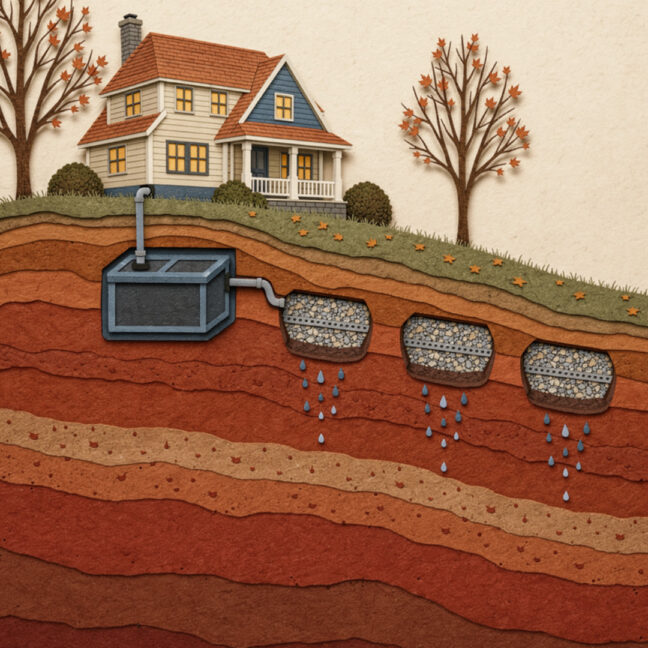
Every drain field we open up in Alpharetta, Milton and Roswell has the same thing waiting at the bottom of the trenches. It’s a thin, dark, jelly-like layer stuck to the soil, and most homeowners have never heard of it. It’s called the biomat, and whether your drain field lasts five years or thirty depends a lot on how that layer is treated.
With the wet months coming to North Fulton, this is a good time to understand it.
What the biomat is
When liquid leaves your septic tank, it flows out to the drain field trenches and soaks into the soil. Bacteria living in that wet zone feed on what’s left in the water, and over time they build a living layer along the trench bottom and sidewalls. University of Georgia Extension calls it a “biomat” or “clogging mat.”
That name sounds bad, but you want one. The biomat filters out most of the bacteria and viruses before the water moves deeper into the ground. It also slows the water down so the soil underneath has time to finish the cleaning job. Industry guidance is clear that it can’t be prevented and shouldn’t be.
When a good layer goes bad
Trouble starts when the biomat grows thicker than the soil can handle. Water comes in faster than it can get through, so it backs up in the trenches. Eventually it finds the easy way out, either up to the surface of your yard or back toward the house.
These are the usual reasons it thickens:
- Solids leaving the tank. A tank that’s overdue for pumping, or one with a broken baffle, lets sludge and scum slip out to the field.
- Grease and food waste. The EPA points to solids, greases and fats as things that speed up clogging.
- Too much water at once. Six loads of laundry on a Saturday, a drained hot tub or a leaking toilet can overload the field.
- Rain and runoff. Gutters and driveways that drain onto the field add water the soil was never sized for.
Why winter makes it harder
Our red clay already takes water slowly. From late fall into spring, the ground around the trenches stays wet for weeks at a time. The UGA guidance says that once soil is saturated, it loses its ability to filter. Georgia requires at least two feet of unsaturated soil under a drain field for that reason.
So a biomat that was getting by in August can tip over in January. When a problem shows up only in wet weather, that’s usually a clue the field is near its limit.
Signs your field is struggling
- Soggy, spongy ground or standing water over the trenches when it hasn’t rained
- Grass that’s greener and faster growing in stripes across the yard
- Slow drains or gurgling all over the house
- A sewage smell outside near the field
Can a choked field come back?
Sometimes, if it’s caught early. A drain field rehabilitation guide from the National Environmental Services Center notes that an overloaded field can recover when the household cuts water use sharply, often by around 30 percent, and the soil gets a chance to dry out. Here’s what that looks like:
- Have the tank pumped so fewer solids reach the field.
- Fix running toilets and dripping faucets.
- Spread laundry across the week.
- Send gutters and sump water away from the field.
- Keep cars and heavy equipment off the trenches.
Skip the miracle bottles. The EPA notes that many chemical additives aren’t effective and recommends avoiding them.
If the field is too far gone, we’ll tell you plainly. Our owner and chief operator, Matt Banta, is a licensed, state-certified Georgia septic contractor with more than 20 years in this ground. We handle drainfield repair and replacement, line repair, hydro jetting and inspections across Alpharetta, Milton, Roswell, Johns Creek, Cumming and Sandy Springs. We’re open every day from 7 a.m. to 10 p.m., with emergency service when it can’t wait. Pricing depends on your system and your yard, so ask us for a quote before any work starts.
Take care of that thin layer under your lawn, and it’ll take care of you.
Call Action Septic Tank Service at 770-922-1434 or visit actionseptictankservice.com to schedule service.