
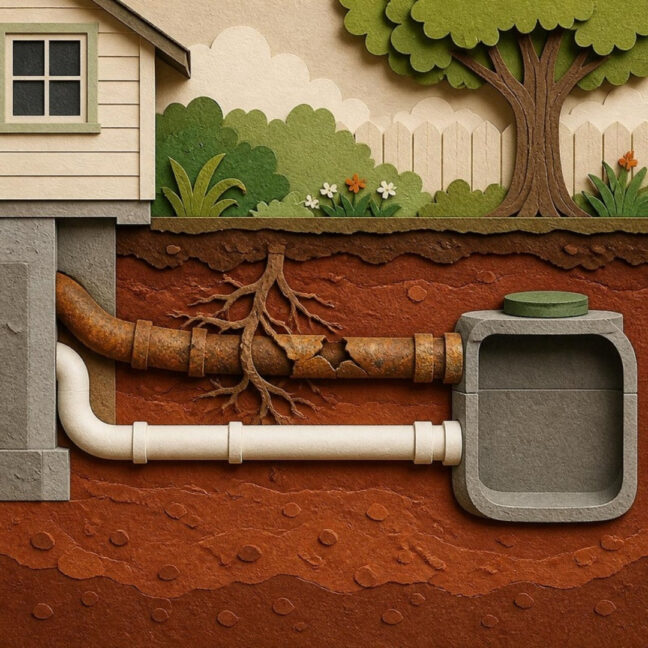
Every septic system starts with one pipe. It leaves your foundation, runs a few feet underground, and carries every flush, shower, and load of laundry to the tank. Nobody thinks about it. Nobody sees it. And on a lot of older North Atlanta homes, it’s older than the people living there.
What’s Probably Down There
Plenty of homes here were built when PVC wasn’t the standard yet. The line to your tank may be one of these:
- Cast iron. Strong when new. Over decades it rusts from the inside, scales up, and narrows until water barely gets through.
- Clay. It holds up well against chemicals, but it’s laid in short sections. Every joint is an open door for roots.
- Concrete. Heavy and durable, until it cracks or the joints separate.
- Orangeburg. A fiber pipe made from wood pulp and coal tar, used for decades until the 1970s. It’s known for a lifespan of roughly 50 years, sometimes far less. As it ages it softens, flattens, and blisters, and it can collapse under the weight of the soil above it.
If your house dates to the 1970s or earlier and nobody’s ever replaced the main line, it’s worth knowing what you have.
What We’ve Pulled Out of These Lines
This isn’t theory. In Sandy Springs, we found the line leaving a septic tank was old cast iron, corroded, completely blocked, and falling apart. The outlet baffle was gone too. We replaced the baffle and the line to the drainfield with PVC and pumped the tank.
In Milton, the main line from the house to the tank was concrete, full of holes and roots, with an old concrete Y fitting buried inside it. We ran a camera through a second line, found it was no longer in use, disconnected it, and replaced the main line with PVC running straight into the tank, along with a new PVC inlet baffle.
Neither homeowner knew what was underground until the camera showed them.
Warning Signs of a Failing Main Line
- Slow drains or backups that keep returning after the tank was pumped
- Gurgling in the lowest drains
- A soggy or sunken strip of lawn between the house and the tank
- Roots pulled out every time the line is cleared
- An odor near the foundation where the pipe exits
Why Replacement Beats Patching
You can clear an old line again and again. Each clearing buys time, and each one costs money. When the pipe itself is the problem, cracked, collapsed, rusted shut, or full of root-filled joints, the lasting fix is a new line.
We replace these lines with PVC. It doesn’t rust, it doesn’t rot, and its joints are glued tight, so roots have a much harder time getting in. Done once, done right, and you stop thinking about that pipe for a very long time.
Find Out What You Have
A camera inspection shows exactly what’s in the ground before anyone digs. Action Septic Tank Service handles line repair and replacement, sewer line work, and backhoe work across North Atlanta, and we’ve done it for more than twenty years. We’re open daily from 7 a.m. to 10 p.m.
Call Action Septic Tank Service at 770-922-1434 or visit actionseptictankservice.com to schedule service.