
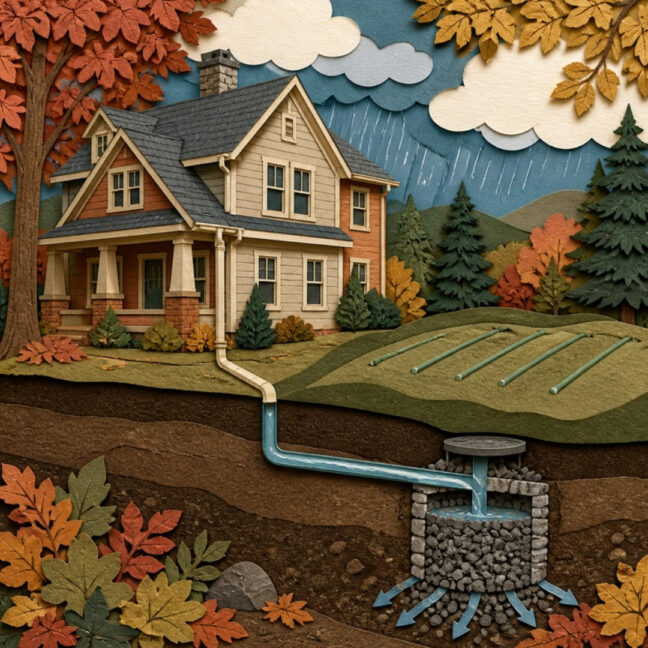
This time of year, leaves pile into gutters all over Alpharetta and Milton, and the fall rains start stacking up. Most homeowners think about where the leaves go. Fewer think about where the water goes once it leaves the downspout. If your home is on septic, that second question matters a lot.
Why roof water and drain fields don’t mix
Your drain field is where the real treatment happens. Wastewater leaves the tank and soaks slowly into the soil, where it gets filtered and cleaned. That only works when the soil has room to breathe. The EPA advises keeping roof drains, sump pumps and other rainwater drainage away from your drain field, because excess water slows down or stops the treatment process.
A roof is a big collection surface. Every downspout gathers the rain off a whole section of it and drops it in one spot. Point that spot at your drain field and you’re soaking the one part of your yard that needs to stay the least soggy. Add North Georgia red clay, which drains slowly to begin with, and the ground can stay saturated for days.
Signs your runoff is landing in the wrong place
- Downspouts that empty onto the lawn uphill from the drain field
- Spongy ground over the field a day or two after a rain
- Slow drains or gurgling toilets that show up after storms and fade in dry weather
- Bright green stripes or standing water over the field lines
- Soil washing away around the tank lid or risers
None of these automatically mean your system is failing. They mean water is going where it shouldn’t, and that’s usually a fixable problem.
Simple fixes you can handle
- Clean your gutters after the leaves drop. Clogged gutters overflow at random spots, often right along the foundation or across the yard.
- Add downspout extensions or splash blocks that send water away from the tank and drain field.
- Walk your yard during a good rain. Watching where the water actually runs tells you more than any drawing.
- Keep a healthy grass cover over the field. Grass holds the soil in place and uses up some of the moisture.
When a dry well makes sense
Sometimes there’s no easy place to send the water. Lots in Milton, Roswell and Johns Creek can be sloped, tight or wooded, and the only downhill direction runs right across the septic area. That’s where a dry well can help.
A dry well is an underground pit, usually filled with gravel or built around a perforated chamber, that collects roof runoff through a buried pipe and lets it soak into the ground slowly. Instead of sheeting across your yard, the water goes to a spot built to take it.
We install dry wells for homeowners around North Fulton, and location is everything. It has to sit far enough from the tank and drain field that the water it releases doesn’t drift right back toward them, and it has to suit the soil it’s going into. Setback and permit requirements can vary, so we check what applies to your property before we dig.
Before you build, regrade or add a patio
Any project that changes how water moves across your yard can change how much reaches your drain field. New gutters, a room addition, a wider driveway, even fresh landscape beds can redirect runoff. If you’re planning work this fall or winter, it helps to know where your tank and field lines are first. We can locate them, look at the drainage, and tell you whether downspout changes, a dry well, or nothing at all is the right move.
The short version
Your septic system was designed to handle what comes out of your house. It wasn’t designed to handle what comes off your roof. Keep those two jobs separate and your drain field has a much better shot at a long life. Matt Banta and our crew have been doing this work around Alpharetta for more than 20 years, and we’d much rather help you move a downspout than replace a drain field.
Call Action Septic Tank Service at 770-922-1434 or visit actionseptictankservice.com to schedule service.