
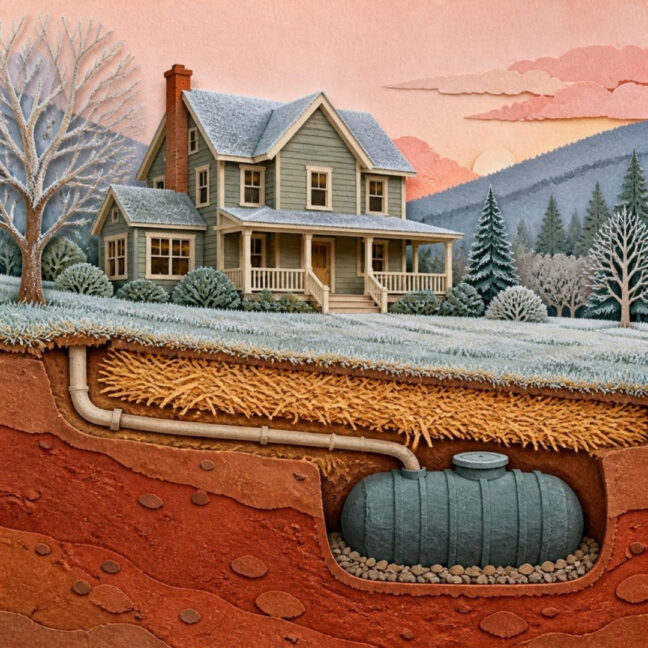
It’s 19 degrees at six in the morning, and the whole house is quiet. You run the shower and the water goes down fine. Then the toilet won’t drain, and somewhere under the yard something that worked yesterday has stopped.
People up north plan for this all winter. Down here we get a handful of hard freezes a year, and they catch us flat-footed. Most North Atlanta septic systems sail through. A few don’t, and the ones that freeze nearly always fail at the same weak spots.
Where Freezing Actually Starts
The tank itself rarely freezes. It’s buried, it’s large, and the waste inside gives off a little heat. The trouble starts in the smaller, shallower parts of the system:
- The line from the house to the tank, especially where it leaves the foundation or runs shallow
- Exposed pipe under a deck, in a crawlspace, or along a slope where soil washed away
- Pump chambers and the lines feeding them, on homes with a pump or an alternative system
- Lines that carry a slow trickle, like a running toilet or a dripping faucet. A trickle freezes long before a full flush does.
Before the Freeze Arrives
You don’t need much. A few small moves cover nearly every risk we see:
- Fix running toilets and dripping faucets now. A slow drip sends a thin stream down the line all night, and that thin stream is the first thing to turn to ice.
- Look for exposed pipe where the line leaves the house or crosses a bank. Wrap it with pipe insulation, or cover it with soil.
- Put down a layer of straw or leaves over the line between the house and the tank if it runs shallow, or if the grass over it is thin or bare. Cold-climate guidance calls for 8 to 12 inches of loose mulch. We seldom need that much, but a few inches over a shallow line helps.
- Keep the tank on schedule. A system that’s already struggling doesn’t need a cold night pushing it over the edge.
- Keep cars and heavy equipment off the line and the field. Compacted soil loses its insulation and lets frost reach deeper.
During the Cold Snap
Use water like you normally would. Space out laundry and dishes so warm water moves through the system during the day. Don’t leave a faucet running all night to “keep it moving.” That trick backfires on a septic system and can flood the drain field.
If you’re traveling over the holidays and the house will sit empty through a freeze, ask a neighbor to run some water every day, or talk with us about service before you leave.
If Something Freezes
Stop using water and call. Then avoid the shortcuts:
- No antifreeze, salt, or additives poured down the drain
- No fire or heater set on the ground over the system
- No running water nonstop to try to thaw it
- No digging into frozen ground over the lines yourself
Short Georgia freezes often thaw on their own within a day or two. A line that stays frozen, or a pump that won’t restart, needs a professional to look at it.
We Answer the Phone When It’s Cold
Action Septic Tank Service has kept North Atlanta systems running through more than twenty Georgia winters. If a cold snap shuts your system down, call us. We’re open daily from 7 a.m. to 10 p.m. and provide emergency service.
Call Action Septic Tank Service at 770-922-1434 or visit actionseptictankservice.com to schedule service.