
Buying or Selling a Home With Septic in North Fulton: What to Check Before Closing

Paper cut-out illustration of a couple checking an open septic tank lid in the backyard of a North Georgia home for sale

Fall is a busy stretch for house hunting around Alpharetta, Milton and Johns Creek, and plenty of those homes sit on septic. The tank is the one major system nobody sees on a walkthrough. You can open the breaker panel and run every faucet in the house, but the tank and drain field stay buried under the lawn.

We get called out to a lot of yards in the middle of a sale. Sometimes it’s the buyer’s agent, sometimes the seller. A little homework up front keeps a closing on track, and it keeps a new owner from inheriting a surprise.

For buyers: ask for the paper trail first

Before you fall for the backyard, ask the seller for:

  • Pumping and service records, with dates
  • The age of the system and any repairs done on it
  • The permit or “as built” drawing showing where the tank and drain field sit

The EPA’s homebuyer guide points people to the local health department for that as-built drawing. Here, that’s Fulton County Environmental Health, and the North Fulton Regional Health Center office can steer you the right way. Older homes in Roswell and Sandy Springs sometimes come with a thin file. Don’t panic if the records are light. It just means the inspection carries more weight.

Know what your home inspection covers

A lot of general home inspections stop at the foundation. The inspector may flush toilets and watch the drains, and that tells you very little about what’s happening out in the yard. Ask your inspector point blank whether the septic system is included. If it isn’t, book a separate septic inspection.

What a real septic inspection looks at

When we inspect a system for a sale, we check the same basics the EPA lists:

  • Sludge and scum levels inside the tank
  • The condition of the tank, the baffles, and the inlet and outlet pipes
  • Signs of backup, like staining above the outlet
  • Signs of leaking, like a water level sitting too low
  • The distribution box, so each drain line gets an even share
  • The drain field, where we look for soggy ground, standing water or odor

In our red clay, the drain field is where trouble likes to hide. Clay holds water. A field that’s been overworked for years can give itself away with a strip of grass greener than the rest of the yard, or ground that stays mushy days after a rain.

For sellers: get ahead of it

If you’re listing a home in Cumming, Milton or Alpharetta, think about having the tank pumped and inspected before the sign goes up. You hand the buyer clean records, you find any problem on your own schedule instead of during a tight due diligence window, and you take a big bargaining chip off the table. A few things help:

  • Locate the lid, or add a riser so it’s easy to reach
  • Pull together every receipt you can find
  • Fix small issues like a cracked lid or a worn baffle before they land on someone else’s report

Pumping and inspecting are two different things

A freshly pumped tank looks great, but pumping by itself doesn’t prove the system works. Pumping is often part of a good inspection because it lets us see the tank walls and baffles. Either way, ask for a written report you can hand to the other side.

If something turns up

A problem doesn’t have to kill the deal. A broken baffle or a cracked line is usually a quick fix. A failing drain field is a bigger job, and that’s where buyers and sellers tend to negotiate repairs or credits. A clear estimate from a licensed contractor gives both sides real numbers instead of guesses. Every property is different, so we quote after we’ve seen the site.

A local set of eyes

Matt Banta has spent more than 20 years inspecting, pumping and repairing systems across North Fulton as a licensed, state-certified Georgia septic contractor. We know the soils, the older neighborhoods and how systems around here tend to age. Whether you’re buying your first place in Peachtree Corners or selling the family home in Roswell, we’ll give you an honest look at what’s underground.

Call Action Septic Tank Service at 770-922-1434 or visit actionseptictankservice.com to schedule service.

Holiday Guests and Your Septic Tank: How to Host a Full House Without a Backup

Paper cut-out illustration of a North Georgia home hosting holiday guests, with cars in the driveway, a septic lid and the drain field in the yard

Every year, right around the week of Thanksgiving, our phone starts ringing with the same story. The house in Milton or Johns Creek is full. Cousins in the guest room, kids on air mattresses, a turkey in the oven and a sink full of pans. Then somebody notices the downstairs toilet gurgling, or the shower drain won’t empty. A septic system that worked fine for a family of four is suddenly trying to keep up with twelve.

Good news: you don’t have to cancel the gathering. You just have to give your tank a little help. Here’s how we tell our customers in Alpharetta, Roswell and Cumming to get ready.

Why a Full House Hits Your Tank So Hard

Your septic tank works on time. Wastewater comes in, solids settle to the bottom, grease floats to the top, and the clearer liquid in the middle moves out to the drain field. That settling only happens if the water sits in the tank long enough.

The EPA puts typical indoor use at up to 70 gallons per person per day. Add six or eight guests for a long weekend and you can double what your system normally sees. Water rushes through faster, solids get pushed toward the outlet, and the drain field gets more than it can soak up. Here in North Georgia, with our tight red clay, that soil already drains slower than you’d like.

Before Everyone Arrives

The best thing you can do happens a few weeks out, not the morning of.

  • Think about your last pumping. Most household tanks need it every three to five years. If you’re at the edge of that window, or you can’t remember the last time, get it done before the holidays, not after.
  • Fix that running toilet. A single leaky toilet can waste up to 200 gallons a day. That’s a lot of extra water your system doesn’t need on its busiest week.
  • Keep the drain field clear. Don’t let guests park on it. The weight of a car packs the soil down and can crack the pipes underneath. If you need overflow parking, put out a few cones or point folks to the street.
  • Check where your gutters drain. Late fall rain plus a full house is a hard combination. Downspouts should send water away from the field, not onto it.

While They’re Staying With You

  • Spread out the laundry. Doing every load in one day can flood the drain field. Run one or two a day instead of six on Saturday, and only run full loads.
  • Space out the showers. If you can, have some folks shower at night and some in the morning so the tank isn’t taking it all at once.
  • Run the dishwasher full. Scrape plates into the trash first. Go easy on the garbage disposal, since every scrap it grinds ends up as solids in your tank.
  • Put a small trash can in each bathroom. Guests don’t always know your house is on septic. Wipes, even the ones labeled flushable, along with feminine products and paper towels belong in the can, not the toilet.

The Turkey Grease Problem

This is the big one. After the meal, someone always wants to pour the roasting pan down the sink with a little hot water. Please don’t. Cooking grease, butter and gravy cool and harden in your pipes and add to the scum layer in your tank. Let it cool, pour it into an old can or jar, and toss it in the trash.

Signs Your System Is Struggling

Keep an eye out for these during the visit:

  • Gurgling sounds in drains or toilets
  • Sinks and tubs draining slower than normal
  • A sewage smell near the tank or in the yard
  • Wet, spongy ground over the drain field

If you notice any of these, ease off the water right away. Hold the laundry, keep showers short, and give the tank a chance to catch up. If things don’t settle down, that’s the time to call us. We’re open every day from 7 a.m. to 10 p.m., and we handle emergencies across North Fulton.

A little planning now means your family remembers the food and the stories, not the backed-up bathroom. Matt and our crew have spent more than 20 years helping North Atlanta households through the busy season.

Call Action Septic Tank Service at 770-922-1434 or visit actionseptictankservice.com to schedule service.

The Effluent Filter: The Small Part Standing Between Your Tank and Your Drain Field

Paper cut-out cutaway of a septic tank with a cylindrical filter at the outlet catching solids before clear water flows to the drain field

Your drain field is the most expensive part of your septic system to replace. On many tanks, the thing protecting it is a plastic cylinder about the size of a coffee can.

It’s called an effluent filter, and most homeowners have never heard of it, even when they have one.

What It Does

Inside your tank, solids sink to the bottom and grease floats to the top. The liquid in the middle is what flows out to the drain field. That liquid is supposed to be fairly clean, but small particles still drift along with it: bits of food, lint, hair, fine sludge.

Without a filter, those particles ride straight into the drain field pipes and settle into the gravel and soil. Over years they build up and seal the ground, so water can’t soak in anymore. That’s how a lot of drain fields die.

An effluent filter sits at the tank’s outlet and catches those particles before they leave. It’s a simple screen with a big job.

Signs Your Filter May Be Clogged

The filter does its job by holding on to debris, so eventually it fills up. When it does, water backs up in the tank. You may notice:

  • Slow drains throughout the house
  • Gurgling toilets
  • Water backing up into the lowest drain
  • A tank that looks overfull even though it was pumped not long ago

Those symptoms look a lot like a full tank, which is why a filter gets missed. Pump the tank, never touch the filter, and the backup comes right back.

How Often It Needs Cleaning

It depends on the filter, the household, and habits like garbage disposal use and laundry volume. Some local health departments recommend checking and cleaning it at least once a year. A good rule is to have it checked every time the tank is pumped or inspected, and more often in a busy household.

Why It’s Not a DIY Job

Cleaning means opening the tank, pulling a filter covered in raw sewage, and rinsing it so the debris goes back into the tank, not onto your lawn or into the field. You’re working over an open tank with harmful bacteria and gases. Leave it to a professional who has the right gear and knows how to put it back properly.

Don’t Have One?

Not every tank has a filter. Many older systems have only an outlet baffle. During a visit, we can tell you what your tank has and whether a filter makes sense for your system.

Protect the Part That Costs the Most

A clean filter costs little. A failed drain field costs a lot. Action Septic Tank Service checks baffles and filters as part of pumping and inspections across North Atlanta, and we’ve done it for more than twenty years. We’re open daily from 7 a.m. to 10 p.m.

Call Action Septic Tank Service at 770-922-1434 or visit actionseptictankservice.com to schedule service.

Septic Tank Lid Safety: The Backyard Hazard Families Forget About

Paper cut-out illustration of a child and dog playing in a backyard at a safe distance from a secured, flush septic tank lid

It looks like a plain round lid in the grass. Kids jump on it. The dog naps on it. The mower rolls right over it every week. Most of the time, nothing happens.

But under that lid sits a deep tank of wastewater and gas, and every year somewhere a lid cracks, slides, or gives way. It’s one of the few places in an ordinary backyard where a small mistake can turn very serious, very fast.

Why a Septic Tank Is Dangerous

  • Falling in. A tank can be several feet deep and full of liquid. A child or pet who falls in can’t climb out alone.
  • Gases. A working tank produces gases, including hydrogen sulfide and methane. They can push oxygen out of the space inside. People have lost consciousness simply leaning in to look, and would-be rescuers have gone in after them and been overcome too.
  • Weak covers. Old concrete lids crack and crumble. Some older tanks have lids that were never meant to carry weight, and they sit just under a thin layer of soil where no one can see them.

A Five-Minute Lid Check

Walk out and look at your tank access points:

  • Is the lid cracked, chipped, or crumbling?
  • Does it sit flat and tight, or does it rock when you step near it?
  • Is it held down with screws or a lock, if it’s the type that should be?
  • Has the ground around it sunk or washed out?
  • Do you know where every access point is, including any buried ones?

If you can’t find your lids, that’s worth fixing too. Records from your last pumping, or the county’s septic permit drawing, usually show the location.

House Rules That Keep Everyone Safe

  • Teach kids the lid isn’t a play spot.
  • Never let anyone lift a lid without a professional on site.
  • Never enter a septic tank, for any reason. Not to grab a dropped tool, not to look at a pipe, not to rescue a pet. Call 911 and call us.
  • Don’t drive or park on the tank or its lids.
  • Keep fire, cigarettes, and sparks away from an open tank. Methane can ignite.

Risers and Secure Lids

Some homes have lids buried several inches underground, which means digging every time the tank needs service, and lids no one can see. A riser brings the access up to ground level so it’s easy to find and service. Paired with a secure, fastened cover, it keeps the opening visible, closed, and out of curious hands.

Let Us Take a Look

During pumping or an inspection, we look at the lids, the access points, and the ground around the tank, and we’ll tell you plainly if something needs attention. Action Septic Tank Service has worked North Atlanta backyards for more than twenty years.

If your lid is cracked, loose, or missing, rope off the area and call us today. We’re open daily from 7 a.m. to 10 p.m.

Call Action Septic Tank Service at 770-922-1434 or visit actionseptictankservice.com to schedule service.
Is It a Plumbing Clog or a Septic Problem? How to Tell Before You Call

Paper cut-out cutaway of a two-story house with its drain pipes joining into one main line that runs to a septic tank, with a magnifying glass over the junction

The kitchen sink won’t drain. Is that a plumber’s job, or is it the septic tank?

It’s one of the most common questions we get, and the answer saves people real money. Call the wrong trade and you pay for a visit that doesn’t fix anything. Here’s how to narrow it down in about five minutes, without touching a tool.

Ask One Question: How Many Drains?

One fixture acting up almost always means a local clog. A slow bathroom sink is usually hair. A slow kitchen sink is usually grease and food. A single toilet that won’t flush right usually has something stuck in its own trap. The rest of the house works fine, because the blockage is between that fixture and the main line.

Several fixtures acting up at once points downstream. The kitchen, the tubs, and the toilets all share one main line out of the house, and that line feeds the septic tank. When everything slows down together, the problem sits where they all meet: the main line, the tank, or the drain field.

Watch the Lowest Drains

Water takes the easiest way out. When the main line or the tank backs up, wastewater comes up first through the lowest openings in the house: a basement floor drain, a lower-level shower, a downstairs toilet.

Try this. Run the washing machine or a bathtub upstairs, then watch the downstairs shower drain. Water bubbling up, or a toilet gurgling down there, means the backup is past your indoor plumbing.

Clues That Point to the Septic System

  • Slow drains all through the house
  • Gurgling in toilets when other fixtures run
  • Sewage odor outside near the tank or drain field
  • Soggy ground or unusually green grass over the field
  • Trouble that’s worse after heavy rain or a big laundry day
  • No record of pumping in the last three to five years

Clues That Point to Indoor Plumbing

  • A single fixture is slow and everything else is fine
  • The problem started right after something went down that drain
  • A plunger or clearing that one trap fixes it for good

What Not to Do

Don’t pour chemical drain cleaner down a drain when you suspect the septic system. It won’t reach a full tank, and harsh chemicals can kill the bacteria the tank depends on. Don’t keep flushing to “see if it clears.” And when more than one drain is backing up, stop running water until somebody looks at it.

When It’s Past the House

When the trouble is in the main line, the tank, or the field, that’s our work. Action Septic Tank Service handles septic pumping, sewer line cleaning, hydro jetting, and line and drainfield repair across North Atlanta, and has for more than twenty years. We’ll find where the blockage actually is and fix that. We’re open daily from 7 a.m. to 10 p.m. and provide emergency service.

Call Action Septic Tank Service at 770-922-1434 or visit actionseptictankservice.com to schedule service.
Cast Iron, Clay, Concrete, or Orangeburg? The Old Pipe Between Your House and Your Tank

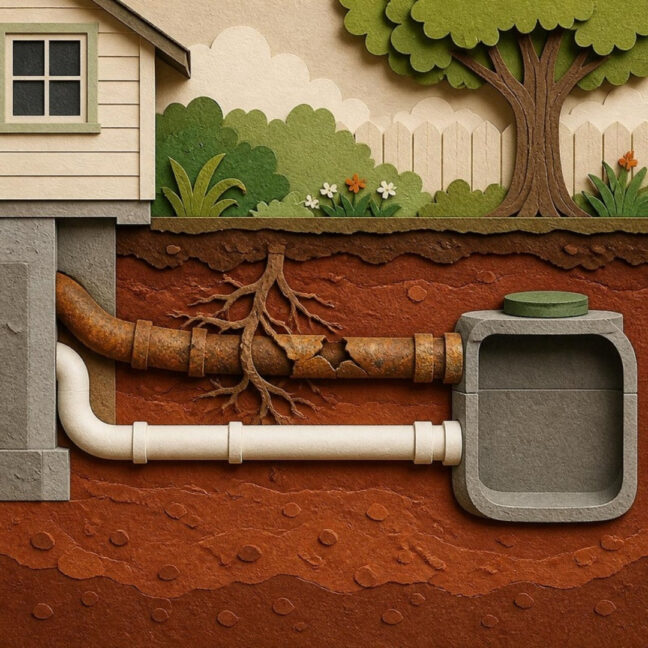
Paper cut-out cutaway of a yard showing an old cracked and root-filled pipe beside a new white PVC line running from a house to a septic tank

Every septic system starts with one pipe. It leaves your foundation, runs a few feet underground, and carries every flush, shower, and load of laundry to the tank. Nobody thinks about it. Nobody sees it. And on a lot of older North Atlanta homes, it’s older than the people living there.

What’s Probably Down There

Plenty of homes here were built when PVC wasn’t the standard yet. The line to your tank may be one of these:

  • Cast iron. Strong when new. Over decades it rusts from the inside, scales up, and narrows until water barely gets through.
  • Clay. It holds up well against chemicals, but it’s laid in short sections. Every joint is an open door for roots.
  • Concrete. Heavy and durable, until it cracks or the joints separate.
  • Orangeburg. A fiber pipe made from wood pulp and coal tar, used for decades until the 1970s. It’s known for a lifespan of roughly 50 years, sometimes far less. As it ages it softens, flattens, and blisters, and it can collapse under the weight of the soil above it.

If your house dates to the 1970s or earlier and nobody’s ever replaced the main line, it’s worth knowing what you have.

What We’ve Pulled Out of These Lines

This isn’t theory. In Sandy Springs, we found the line leaving a septic tank was old cast iron, corroded, completely blocked, and falling apart. The outlet baffle was gone too. We replaced the baffle and the line to the drainfield with PVC and pumped the tank.

In Milton, the main line from the house to the tank was concrete, full of holes and roots, with an old concrete Y fitting buried inside it. We ran a camera through a second line, found it was no longer in use, disconnected it, and replaced the main line with PVC running straight into the tank, along with a new PVC inlet baffle.

Neither homeowner knew what was underground until the camera showed them.

Warning Signs of a Failing Main Line

  • Slow drains or backups that keep returning after the tank was pumped
  • Gurgling in the lowest drains
  • A soggy or sunken strip of lawn between the house and the tank
  • Roots pulled out every time the line is cleared
  • An odor near the foundation where the pipe exits

Why Replacement Beats Patching

You can clear an old line again and again. Each clearing buys time, and each one costs money. When the pipe itself is the problem, cracked, collapsed, rusted shut, or full of root-filled joints, the lasting fix is a new line.

We replace these lines with PVC. It doesn’t rust, it doesn’t rot, and its joints are glued tight, so roots have a much harder time getting in. Done once, done right, and you stop thinking about that pipe for a very long time.

Find Out What You Have

A camera inspection shows exactly what’s in the ground before anyone digs. Action Septic Tank Service handles line repair and replacement, sewer line work, and backhoe work across North Atlanta, and we’ve done it for more than twenty years. We’re open daily from 7 a.m. to 10 p.m.

Call Action Septic Tank Service at 770-922-1434 or visit actionseptictankservice.com to schedule service.
When a Georgia Cold Snap Hits: Keeping Your Septic System From Freezing Up

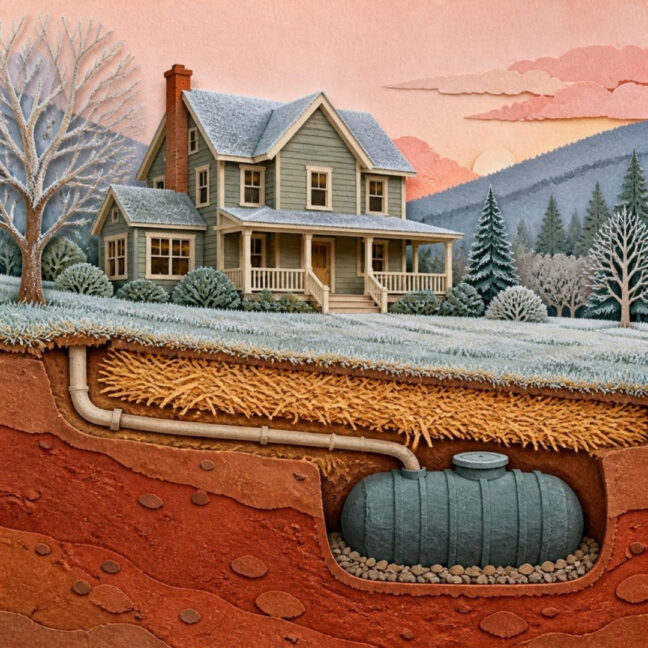
Paper cut-out illustration of a frosty North Georgia house at dawn with a cutaway showing the septic line and tank under a blanket of straw mulch

It’s 19 degrees at six in the morning, and the whole house is quiet. You run the shower and the water goes down fine. Then the toilet won’t drain, and somewhere under the yard something that worked yesterday has stopped.

People up north plan for this all winter. Down here we get a handful of hard freezes a year, and they catch us flat-footed. Most North Atlanta septic systems sail through. A few don’t, and the ones that freeze nearly always fail at the same weak spots.

Where Freezing Actually Starts

The tank itself rarely freezes. It’s buried, it’s large, and the waste inside gives off a little heat. The trouble starts in the smaller, shallower parts of the system:

  • The line from the house to the tank, especially where it leaves the foundation or runs shallow
  • Exposed pipe under a deck, in a crawlspace, or along a slope where soil washed away
  • Pump chambers and the lines feeding them, on homes with a pump or an alternative system
  • Lines that carry a slow trickle, like a running toilet or a dripping faucet. A trickle freezes long before a full flush does.

Before the Freeze Arrives

You don’t need much. A few small moves cover nearly every risk we see:

  • Fix running toilets and dripping faucets now. A slow drip sends a thin stream down the line all night, and that thin stream is the first thing to turn to ice.
  • Look for exposed pipe where the line leaves the house or crosses a bank. Wrap it with pipe insulation, or cover it with soil.
  • Put down a layer of straw or leaves over the line between the house and the tank if it runs shallow, or if the grass over it is thin or bare. Cold-climate guidance calls for 8 to 12 inches of loose mulch. We seldom need that much, but a few inches over a shallow line helps.
  • Keep the tank on schedule. A system that’s already struggling doesn’t need a cold night pushing it over the edge.
  • Keep cars and heavy equipment off the line and the field. Compacted soil loses its insulation and lets frost reach deeper.

During the Cold Snap

Use water like you normally would. Space out laundry and dishes so warm water moves through the system during the day. Don’t leave a faucet running all night to “keep it moving.” That trick backfires on a septic system and can flood the drain field.

If you’re traveling over the holidays and the house will sit empty through a freeze, ask a neighbor to run some water every day, or talk with us about service before you leave.

If Something Freezes

Stop using water and call. Then avoid the shortcuts:

  • No antifreeze, salt, or additives poured down the drain
  • No fire or heater set on the ground over the system
  • No running water nonstop to try to thaw it
  • No digging into frozen ground over the lines yourself

Short Georgia freezes often thaw on their own within a day or two. A line that stays frozen, or a pump that won’t restart, needs a professional to look at it.

We Answer the Phone When It’s Cold

Action Septic Tank Service has kept North Atlanta systems running through more than twenty Georgia winters. If a cold snap shuts your system down, call us. We’re open daily from 7 a.m. to 10 p.m. and provide emergency service.

Call Action Septic Tank Service at 770-922-1434 or visit actionseptictankservice.com to schedule service.

7 Warning Signs Your Septic Tank Needs Immediate Service

Your septic system whispers before it screams.

The key is catching the warning signs early.

Here are the most common red flags we see in North Georgia homes.

1. Slow Drains Throughout the House

If one sink is slow, it may be a clog.
If multiple drains are slow, your septic tank may be full.

2. Gurgling Sounds

Toilets or drains making bubbling noises often signal restricted flow.

3. Sewage Odor Indoors or Outdoors

If you smell sulfur or sewage near your yard or inside your home, do not ignore it.

4. Pooling Water in the Yard

Standing water near the drain field — especially without recent rain — is a serious warning.

5. Lush, Bright Green Grass Over the Drain Field

It may look healthy, but it can mean wastewater is surfacing.

6. Sewage Backup in Toilets or Tubs

This is a full emergency situation.

7. It’s Been Over 3–5 Years Since Your Last Pump

Even without symptoms, time alone can justify service.

What To Do Next

If you’re experiencing one or more of these signs, call immediately. Waiting can turn a manageable pump-out into a major repair.

Preventative maintenance is always cheaper than restoration.

How Often Should You Pump Your Septic Tank in Alpharetta?

This is one of the most common questions we get.

The answer depends on three things:

Household size

Tank size

Water usage habits

General Rule

Most residential septic tanks in North Georgia should be pumped every 3 to 5 years.

But that’s not universal.

Larger Households

More people = more wastewater = faster sludge accumulation.

A household of five may need pumping closer to every 2–3 years.

Garbage Disposals Increase Load

If you regularly use a garbage disposal, your tank fills faster.

Vacation Homes

Homes used seasonally may stretch closer to the 5-year mark.

Why Pumping Matters

Inside your septic tank, solids settle at the bottom. Over time, that layer thickens.

If it grows too high:

Solids escape into the drain field

Lines clog

The system fails

Drain field replacement can cost thousands.

Routine pumping costs a fraction of that.

Smart Move

If you’re unsure when your last service was, schedule an inspection. It’s better to know than guess.

Why Septic Systems Fail in North Georgia (And How to Prevent It)

If you live in North Georgia, your septic system works harder than you think.

Clay-heavy soil. Sudden rainstorms. Expanding suburban development. All of it impacts how your system performs — and how long it lasts.

Most septic failures don’t happen overnight. They build quietly. Then suddenly you’re dealing with sewage backups, foul odors, or a soaked yard.

Here’s what causes most failures in the Alpharetta and surrounding areas.

1. Poor Drainage from Clay Soil

North Georgia soil doesn’t drain like sandy coastal regions. Clay holds water. That means when heavy rains hit, your drain field may already be saturated.

When the soil can’t absorb more wastewater, it backs up.

Prevention:

Pump every 3–5 years

Redirect gutters away from the drain field

Avoid compacting soil over the field

2. Skipping Regular Pumping

Many homeowners wait until there’s a problem.

That’s a mistake.

Sludge builds up over time. If it’s not removed, it pushes solids into the drain field. Once that happens, repairs get expensive — fast.

Routine pumping costs far less than replacing a failed field.

3. Flushing the Wrong Things

“Flushable” wipes are not septic-safe. Neither are paper towels, grease, or feminine hygiene products.

Your system is designed for:

Human waste

Toilet paper

That’s it.

Everything else increases the risk of clogs and overflow.

4. Heavy Vehicle Traffic

Parking trucks or equipment over your septic tank or drain field compresses soil and can crack pipes.

We’ve seen it too many times.

The Bottom Line

Septic systems in Alpharetta and surrounding North Georgia communities require proactive care. Regular inspections and pumping extend the life of your system and prevent emergencies.

If it’s been more than three years since your last pump, schedule service now — before the problem announces itself.